Beyond the Spreadsheet — Enterprise Finance Inside the Engineering Loop
Most mining studies treat finance as a spreadsheet bolted on at the end. IMC embeds enterprise finance — debt, tax, dynamic NPV and three full statements — natively inside the engineering loop.
The legacy model: finance as an afterthought
In the traditional workflow finance happens last: a modeller builds a fresh spreadsheet, types in factored cost assumptions and produces a static NPV, disconnected from the engineering. The model is opaque, fragile, and structurally disconnected from the cost of a tonne.
The IMC model: finance native to the loop
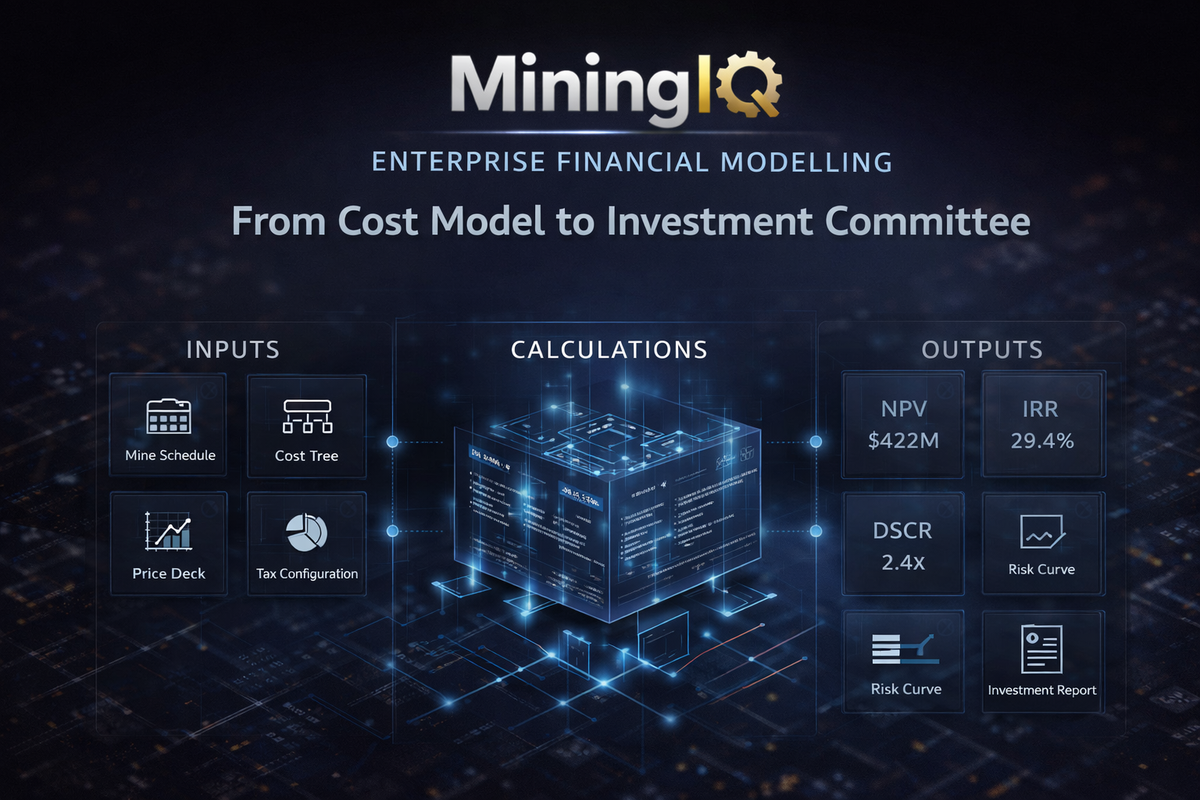
Through MiningIQ, enterprise finance is part of the optimisation loop. Built on a strict separation of inputs, calculations and outputs and a chart of accounts mapped to statement line items, but purpose-built for mining, it produces:
- Complete three-statement output — income statement, balance sheet and cash flow, period by period across life of mine, where the balance sheet balances and cash flow reconciles.
- Multi-jurisdiction fiscal modelling — corporate tax, royalties, mining levies, loss carry-forward, interest-deductibility caps and tax depreciation, with effective government take.
- Instrument-level financing — drawdowns, repayment profiles, grace periods, covenant and DSCR monitoring, and automatic peak-funding identification.
- Bayesian (correlated) risk analysis — thousands of full-model evaluations with realistic correlation, producing calibrated P10–P90 distributions, not naive Monte Carlo.
The differentiator: FAST- and Modano-structured output
Here is what sets IMC apart. The model exports a fully structured workbook in the two modelling standards large accounting and advisory firms actually use:
- F1F9 / FAST standard — one row, one unit, one formula; left-to-right time axis; dedicated input/calculation/output sheets; check rows that must sum to zero; the blue-input / black-formula / green-link / red-check colour code; cross-sheet references emitted as live formulas, never dead pasted values.
- Modano BFS standard — the modular F-C-W-P layout (cover, scenario switcher, macro/price decks, assumptions, schedule, calculation bridge, annual and monthly three-statement output, and a headline result sheet with NPV, IRR, FCF and payback) in Modano’s classic colour conventions.
Because the export is built from the same engine that ran the study, the workbook a lender’s adviser or a Big-4 auditor receives is the live model, in the format they already know, with the audit trail intact.
Closing the loop: from MineCost to the financial statements
Operating and capital costs flow from MineCost’s zero-based work breakdown structure into the financial model through a controlled, version-tracked mapping to the chart of accounts — so the cost of a tonne in the income statement traces back to the rimpull curve of the truck that moved it.
Techno-economic model vs corporate financial model
There is a structural difference most clients only discover late, and it decides whether your study is financing-ready. Mining engineering firms typically stop at a techno-economic model (TEM) — essentially a single-tab discounted-cash-flow sheet that returns project-level, often pre-tax, NPV and IRR from their cost estimate. A TEM is not a corporate financial model: it does not produce a fully dynamic three-statement model (income statement, balance sheet and cash flow), instrument-level debt structuring and DSCR, proper tax-shield and multi-jurisdiction fiscal treatment, or the accounting architecture lenders require.
For project finance or an equity raising, a TEM is not enough — so the traditional path forces you to hire a second firm (a corporate financial adviser or accountant) to take the engineering firm’s flat numbers and rebuild them into a proper financial engine. That hand-off is slow, costly, and breaks the audit trail back to the mine physics.
IMC closes that gap in one workflow. The MiningIQ enterprise model is an institutional-grade, three-statement corporate financial model — instrument-level debt (drawdowns, repayments, covenants, DSCR), multi-jurisdiction tax, and correlated Bayesian risk — built to the FAST and Modano conventions and tied directly to the block model and haulage physics. You get a complete, lender-ready financial asset from day one: more bankable, and cheaper to execute, because there is no second firm to engage and no rebuild.
Speed is the by-product — bankability is the point
Running hundreds of what-if scenarios quickly is the headline, but it is not the real advantage. The real advantage is that the model is more bankable. A legacy study hands a lender a static, hand-built spreadsheet whose cost and revenue assumptions cannot easily be traced back to the engineering — a lender’s independent engineer cannot reproduce it without rebuilding it. IMC hands over an auditable model in the FAST and Modano conventions, where every number traces from the block model and haulage physics through MineCost to the financial statements — the format banks’ modelling teams and Big-4 auditors already work in, with live formulas and check rows. For project finance and an ITR, that traceability is what makes the model defensible, not just fast.
Why this beats a static spreadsheet for financing
- Reproducible by the lender’s adviser — the independent engineer can follow and re-run the logic rather than take it on trust.
- One source of truth — a change to the mine sequence flows automatically to opex, capex and cash flow, so the model the investment committee sees is internally consistent, with no version-drift between disconnected spreadsheets.
- Correlated (Bayesian) risk — calibrated P10–P90 economics a credit committee can stand behind, not naive single-point or independent Monte Carlo outputs.
- Lender- and auditor-native formats — FAST and Modano workbooks, so diligence is faster and the model is trusted on sight.
So the integrated model is both the most agile and the most bankable option — you do not trade speed for financing credibility. (See The Modern Bankable ITR and From Block Model to Corporate NPV.)
Frequently Asked Questions
What is the difference between a techno-economic model (TEM) and a corporate financial model?
A techno-economic model is a single-tab discounted-cash-flow sheet that returns project-level (often pre-tax) NPV and IRR from a cost estimate. A corporate financial model is a full three-statement model (income statement, balance sheet, cash flow) with debt structuring, tax treatment and accounting architecture to standards lenders accept. Most engineering firms deliver a TEM; IMC delivers the full corporate model.
Will I need a separate financial advisory firm as well as my technical consultant?
Not with IMC. Where an engineering firm’s TEM has to be rebuilt by a second firm into a bankable corporate model, IMC delivers the institutional-grade three-statement model (FAST/Modano) tied to the mine physics in one workflow — more bankable and cheaper, with no second engagement and no broken audit trail.
Is an integrated financial model actually more bankable than a traditional spreadsheet model?
Yes. A lender’s independent engineer can reproduce an auditable, FAST/Modano model where every number traces to the engineering; a static, hand-built spreadsheet must be taken on trust or rebuilt. That traceability is what makes a model defensible for project finance and an ITR — so the integrated model is more bankable, not just faster.
Which is better for project finance — an integrated model or a legacy spreadsheet model?
An integrated, auditable model is stronger on both counts: faster to iterate and more defensible to lenders and auditors, because it is delivered in the FAST/Modano formats they use with a full audit trail from block model to cash flow.
What does "enterprise finance integrated into the engineering loop" mean?
The financial model is part of the study, not a separate spreadsheet built afterwards. Debt, tax and dynamic discount rates are evaluated inside the same loop that optimises the pit and schedule.
What is the FAST standard?
FAST (Flexible, Appropriate, Structured, Transparent), maintained by F1F9, is a widely adopted financial-modelling standard. A model built to it is transparent and auditable by design; MiningIQ exports structured to this standard.
What is the Modano standard?
A modular financial-modelling standard with a defined sheet structure (F-C-W-P) and colour conventions used in bankable feasibility models. MiningIQ also exports in this format.
How is the risk analysis different from standard Monte Carlo?
IMC uses a Bayesian, correlated approach: thousands of full-model evaluations with realistic correlation between variables, producing calibrated P10–P90 outcomes.
See the enterprise model and a FAST/Modano export live
Book a technical discussion with Stewart Lewis.